The B2B SaaS A/B Testing Framework That Actually Works (When You Have Low Traffic)
How to run statistically valid A/B tests with 500-2,000 visitors/month. A practical framework from 14 real tests, 11 failures, and 3 wins.
The B2B SaaS A/B Testing Framework That Actually Works (When You Have Low Traffic)
Every A/B testing guide on the internet assumes you have 50,000 visitors a month. You don't. If you're running a B2B SaaS product, you probably have somewhere between 500 and 2,000 monthly visitors hitting any given page, and the standard advice about statistical significance, multivariate testing, and "just let it run longer" falls apart at that traffic level.
I know this because I ran 14 A/B tests in 60 days on a B2B SaaS homepage. I wrote about the results in detail, and the headline number was an 18% CVR lift. But the number I didn't talk enough about was this: 11 of those 14 tests failed. Not "underperformed." Failed. And the reason most of them failed wasn't bad hypotheses. It was that our traffic volume made it nearly impossible to detect small effects.
That experience forced me to build a different testing framework, one designed specifically for low-traffic B2B environments. This is that framework.
Why Standard A/B Testing Breaks in B2B SaaS
The math is simple and unforgiving. Standard A/B testing tools like VWO or Optimizely default to a 95% confidence threshold. To detect a 10% relative improvement on a page converting at 3%, you need roughly 30,000 visitors per variation. That's 60,000 total visitors for a simple two-way test.
If you're getting 1,500 visitors a month to that page, you'll need to run the test for 40 months. Three and a half years. For one test.
Nobody does this. Instead, what actually happens at most B2B SaaS companies is one of three things, all of them bad.
They call tests too early. The test has been running for two weeks, results look promising, someone gets impatient and ships the "winner." Except with 750 visitors per variation, you're essentially reading tea leaves. The result is noise, not signal, and you've just made a permanent change to your funnel based on a coin flip.
They test tiny changes. Button color. CTA copy. Headline tweaks. These changes might move the needle by 2-3%, which is completely undetectable at low traffic volumes. You run the test for a month, see no significance, and conclude that "A/B testing doesn't work for us." It does work. You're just testing the wrong things.
They give up entirely. After a few inconclusive tests, the team decides they don't have enough traffic for experimentation. They go back to making changes based on gut feel and best practices, which is how you end up with a landing page optimized for what your design team thinks looks good instead of what your buyers actually respond to.
The Low-Traffic Testing Framework
The framework I built has four principles that deviate from standard testing practice. Each one is a direct response to a constraint that low-traffic B2B environments impose.
Principle 1: Test Big or Don't Test
If you have 1,500 monthly visitors, you can only detect large effects. So stop looking for small ones.
This means you don't test button colors, you test entirely different page structures. You don't test headline variations, you test fundamentally different value propositions. You don't test whether "Start free trial" outperforms "Get started," you test whether leading with a product demo video outperforms leading with a feature list.
During the 60-day sprint, four of our 14 tests showed no statistical significance after two weeks. Three of those four were small changes: a headline rewrite, a CTA copy swap, and a hero image change. The tests that actually reached significance were structural. Moving the product demo video from section four to above the fold. Completely redesigning the CTA section layout. Swapping enterprise logos for mid-market social proof.
The rule: if a change wouldn't be noticeable to a visitor within the first three seconds of seeing the page, don't bother testing it at low traffic. Save micro-optimizations for when you've 10x'd your traffic.
Principle 2: Lower Your Confidence Threshold (Consciously)
This is heresy in traditional experimentation circles, and I don't care. At 1,500 monthly visitors, demanding 95% confidence means you will almost never conclude a test. You're not running a pharmaceutical trial. You're deciding whether version A or version B of a landing page converts better.
I dropped our threshold to 85-90% confidence for most tests. Here's the tradeoff: at 85% confidence, there's roughly a 15% chance you're wrong. At 95%, it's 5%. The difference sounds significant until you consider the alternative, which is making that same decision with 0% statistical backing because you never ran the test at all, or called it after a week with 60% confidence and pretended that counted.
An 85% confident decision is dramatically better than a gut-feel decision. It's not as good as a 95% confident decision, but that option doesn't exist at your traffic level unless you're willing to run tests for six months.
The practical setup: In VWO, I set tests to flag at 85% confidence but didn't auto-ship winners. Instead, I used the 85% threshold as a "strong signal" indicator and combined it with qualitative data (session recordings, scroll maps, click maps) before making a final call. The quantitative data told me what was probably happening. The qualitative data told me why.
Principle 3: Use a Decision Tree, Not a Backlog
Most experimentation programs maintain a flat backlog of test ideas ranked by impact and effort. That works when you can run 10 tests a month. When you can only run 2-3 tests a month, and each one takes 3-4 weeks to reach even reduced confidence, you need to be far more strategic about sequencing.
I built a decision tree that routes you to the right test based on two inputs: your monthly traffic volume and where your funnel is leaking most.
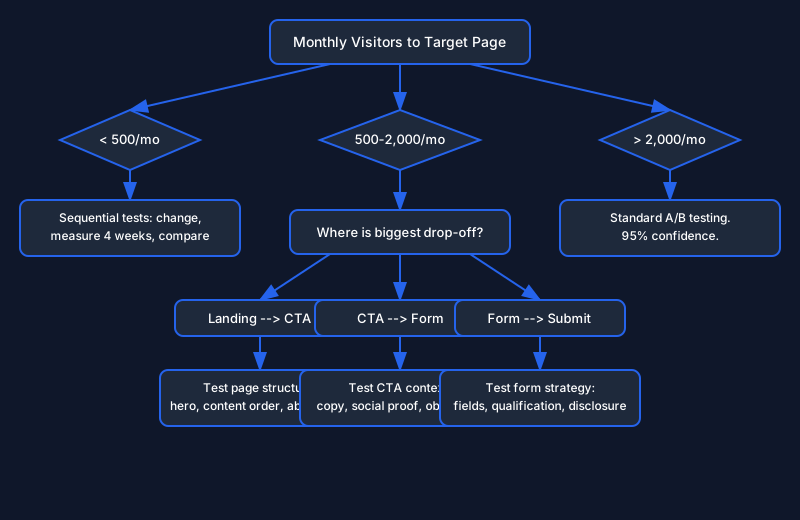
The decision tree works like this:
Under 500 monthly visitors: Don't A/B test. Seriously. You don't have enough data to detect anything. Instead, run sequential tests: make a change, run it for four weeks, compare the before-and-after metrics. It's not as rigorous as a simultaneous test, but it's better than either guessing or waiting 18 months for significance.
500 to 2,000 monthly visitors: A/B test, but only big structural changes, only at 85-90% confidence, and only on the funnel stage where your biggest drop-off lives. If 70% of visitors never scroll past the hero, you don't need to test your pricing section. Test the hero. This sounds obvious, but I've watched companies burn their limited testing capacity on sections that most visitors never see.
Over 2,000 monthly visitors: Standard A/B testing practices apply. Use 95% confidence. Test whatever you want. You're in a traffic range where the tools work as designed.
Principle 4: Stack Winners, Don't Isolate Variables
Traditional experimentation doctrine says to isolate variables. Change one thing at a time so you know what caused the effect. This is excellent advice when you have unlimited traffic and time. You have neither.
In low-traffic environments, I stack winning changes rather than testing them independently. Here's what that looked like in practice. Test 1: new hero layout with video above the fold. Result: positive signal at 88% confidence. Test 2: new CTA section design (run on top of the new hero layout, not against the original). Result: positive signal at 91% confidence. Test 3: new social proof section (run on top of both previous winners).
Yes, this means I can't perfectly isolate how much each change contributed individually. The 18% lift came from all three changes stacked together. Maybe the video was worth 10% and the CTA was worth 5% and the social proof was worth 3%. Or maybe the distribution was completely different. I don't know and, honestly, I don't need to know. What I know is that the combined effect was an 18% improvement, and each individual change showed a positive signal before I stacked the next one on top.
The purist will object. They'll say this methodology is imprecise. They're right. But imprecise progress beats precise paralysis. If I'd insisted on isolating each variable with 95% confidence at our traffic level, I'd still be running test number two. Instead, I shipped 14 tests in 60 days and moved the number that matters.
The Test Prioritization Matrix
Before you run anything, you need to decide what to test first. I use a modified impact-effort matrix with a third axis that most frameworks miss: detectability.
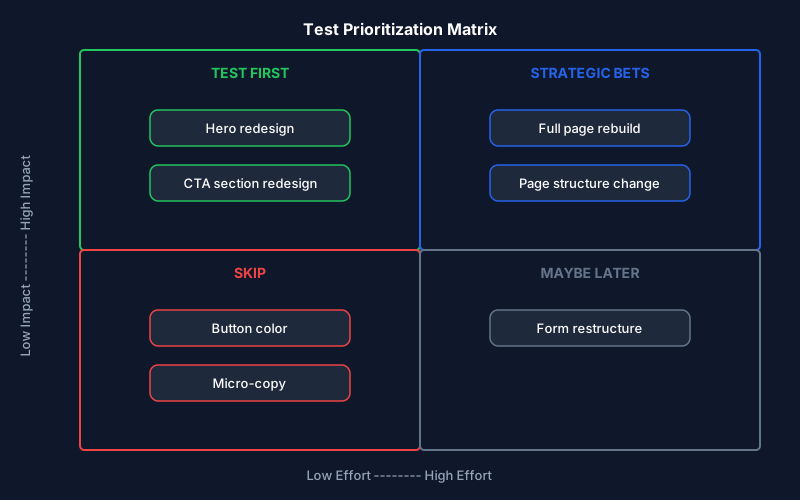
Impact: How much could this change move your primary metric? Structural changes (page layout, information architecture, content ordering) score high. Cosmetic changes (colors, fonts, micro-copy) score low.
Effort: How long does it take to build and deploy the variant? A headline swap is low effort. A complete page restructure is high effort. Factor in design, development, and QA time.
Detectability (the one most people miss): Given your traffic level, can you actually detect this change's effect? A 2% improvement is real, but with 1,000 visitors it's invisible. A 15% improvement shows up even at low traffic. If a change is high-impact but low-detectability at your traffic level, you're wasting a testing slot.
During our sprint, the test prioritization matrix is what kept us from burning cycles on button-color tests. Every proposed test had to pass the detectability filter: "At our traffic level, could we realistically detect this effect within two weeks?" If the answer was no, the test went to the bottom of the backlog, regardless of how good the hypothesis sounded.
Using AI to Generate Better Hypotheses Faster
One bottleneck in low-traffic testing is that you can't afford to waste tests on weak hypotheses. Every test slot is precious. I started using GPT-4 to accelerate hypothesis generation, and it actually works well for one specific part of the process.
Here's the workflow. I export 10-15 session recordings from Hotjar as annotated screenshots and notes, then feed them to GPT-4 with the prompt: "Based on these user behavior patterns, what are the most likely friction points, and what changes would you hypothesize would reduce that friction?" The model generates 15-20 hypotheses in about two minutes.
Most of them are mediocre. That's fine. The point isn't to get perfect hypotheses from the AI. The point is to get a wide net of possibilities that I can then filter through the prioritization matrix. The human judgment, deciding which hypotheses are actually testable and detectable at our traffic level, is still mine. But the brainstorming phase that used to take a full afternoon now takes 30 minutes.
I also use GPT-4 to draft test variation copy faster. Instead of spending two hours writing three headline variants, I generate 20 options in five minutes and pick the three that best match the behavioral insight I'm targeting. Speed matters when you're running a 60-day sprint and every day without a live test is a day of learning lost.
What 11 Failures Taught Me About B2B Testing
The three wins are the ones people remember. The 11 failures are where the actual learning lived.
Failure pattern 1: Testing what you can't detect. Four tests showed no statistical significance because the changes were too small for our traffic to detect. Headline tweaks. CTA copy variations. A hero image swap. Any one of these might have been a real improvement, but at 1,500 monthly visitors, we couldn't tell. These tests weren't failures of hypothesis. They were failures of methodology. We were asking a question our data couldn't answer.
Failure pattern 2: Optimizing the wrong metric. The form field reduction test "worked" if you only measured form submissions. We shortened from 6 fields to 3, conversion rate jumped 11%, and we nearly shipped it. Then we checked pipeline quality. Qualified leads dropped 30%. We'd made it easier for the wrong people to convert. Now every test has two metrics defined upfront: the conversion metric and a downstream quality metric. If one goes up and the other goes down, we don't ship.
Failure pattern 3: Fighting user instincts. We tested removing the navigation bar to reduce distractions and keep visitors focused on the CTA. Bounce rate jumped 15%. Visitors felt trapped, not focused. Another test restructured the page to lead with pricing, hoping that transparency would build trust. Mid-market buyers anchored on the enterprise tier and left. Both tests had reasonable hypotheses backed by published best practices. Both failed because the best practices didn't account for how our specific buyers behave.
The meta-lesson: In low-traffic environments, you can't afford to learn these lessons slowly. Every failed test costs you 2-3 weeks of testing capacity. That's why the prioritization matrix and the decision tree matter so much. They exist to keep you from burning your most limited resource, test slots, on changes that are unlikely to produce detectable, meaningful results.
Setting Up Your Low-Traffic Testing Stack
You don't need a complex infrastructure. Here's what I used, and none of it required engineering resources to set up.
VWO for test deployment. Creates variants visually without code changes. The built-in stats engine handles confidence calculations. The free tier works if you're running one or two tests at a time.
GA4 for measurement. Set up custom events for each funnel stage: page view, CTA click, form start, form submit. Build a funnel report so you can see exactly where visitors drop off. This takes about an hour to configure and it's the single most important piece of your testing infrastructure.
Hotjar or Microsoft Clarity for qualitative data. Session recordings, scroll maps, click maps. At low traffic volumes, qualitative data is your secret weapon. When you can't get statistical significance from numbers alone, watching 30 session recordings will tell you things that no amount of quantitative data can.
n8n for automation. I built a simple workflow that checked VWO results daily and pushed updates to a Slack channel. When a test hit the confidence threshold, the team got notified automatically. When a test needed to be killed, the notification included the data so the decision was immediate. Total build time: about three hours. Time saved over eight weeks: probably 10 hours of manual dashboard checking.
A spreadsheet for your test log. Not a fancy tool. A spreadsheet with columns for: hypothesis, test type, start date, end date, sample size, result, confidence level, decision, and learnings. This becomes your institutional memory. Six months from now, when someone proposes testing the exact thing that failed in test number 7, you'll have the data to explain why.
The 30-60-90 Day Plan
If you're starting from zero, here's how I'd sequence the first three months.
Days 1-30: Foundation. Set up GA4 funnel tracking. Install Hotjar or Clarity. Watch 50 session recordings and build a scroll map of your primary landing page. Identify your biggest drop-off point. Generate 10-15 hypotheses. Filter through the prioritization matrix. Launch your first test: one big structural change targeting your biggest drop-off.
Days 31-60: Velocity. You should have results from test 1 by now (positive signal, negative signal, or inconclusive). If positive, stack the next change on top. If negative, roll back and launch test 2 from your backlog. Aim to have 2-3 tests completed in this window. Start building the discipline of documenting every result, including failures.
Days 61-90: Compounding. By now you have 3-5 test results and a growing understanding of how your specific audience behaves on your specific page. Your hypotheses should be getting sharper because they're informed by actual data, not guesswork. Start looking at secondary pages: pricing page, product page, signup flow. Apply the same framework.
The 18% lift I got didn't happen because of one breakthrough insight. It happened because of a system: a repeatable process for generating hypotheses, prioritizing them for low-traffic conditions, running tests, documenting results, and iterating. The framework is the thing. Individual tests come and go. The framework compounds.
Most B2B SaaS teams I talk to are stuck in the same place. They know they should be testing. They've heard the case studies. They might have even tried a few tests that went nowhere. And they've concluded, quietly, that A/B testing just doesn't work when you don't have B2C traffic volumes.
It does work. You just need a different framework. One that accounts for the constraints instead of pretending they don't exist.
If you want help building this for your team, whether it's setting up the testing infrastructure, running the first round of experiments, or building the prioritization system that keeps your limited testing capacity focused on the right changes, that's exactly what my growth advisory engagement covers. Not running tests for you forever, but building the system so your team runs it independently.
More tactics like this, straight to your inbox.