B2B SaaS Demand Generation vs. Lead Generation: Building Pipeline That Closes
Why most B2B SaaS teams confuse lead gen with demand gen, and how switching your approach compresses deal cycles and improves pipeline quality.
B2B SaaS Demand Generation vs. Lead Generation: Building Pipeline That Closes
Our sales team was drowning in leads. 1,200 MQLs a month. The dashboard looked incredible. Marketing was celebrating. And pipeline was flat.
I sat in a QBR where the VP of Sales pulled up his numbers and said, with zero emotion: "I have 1,200 leads and my team can't close any of them. They're not ready to buy. They downloaded a whitepaper because the LinkedIn ad interrupted their scrolling, and now some SDR is calling them on a Tuesday morning asking if they want a demo of something they've already forgotten about."
That meeting changed how I think about growth. Not because the VP was being dramatic, but because the data backed him up completely. Average deal cycle for those MQLs: 88 days. Win rate: 6%. We were spending real money generating contacts who had zero buying intent, then burning sales capacity trying to nurture them into something they weren't.
Six months later, after rebuilding the entire approach around demand generation instead of lead generation, the numbers looked different. Average deal cycle: 54 days. Win rate: 18%. Pipeline didn't just grow. It got faster and more predictable.
This article is about what actually changed. Not the theory of demand gen versus lead gen, which you can get from any agency blog post. The operational shift inside a real B2B SaaS org, how the marketing-sales handoff evolved, and what metrics started mattering once we stopped optimizing for MQL volume.
The Difference Is Not Semantic. It's Structural.
Most content about demand generation versus lead generation treats it like a terminology debate. "Lead gen captures demand, demand gen creates it." That's technically correct and practically useless, because it doesn't tell you what to actually do differently on Monday morning.
Here's the real difference, as it plays out operationally.
Lead generation is a capture operation. You put up a gate, you offer something behind it (ebook, webinar, template), someone gives you their email to get the thing, and you call that a "lead." The entire motion is designed around one question: how do we get contact information from as many people as possible?
Demand generation is a trust operation. You create content, experiences, and signals that make your target buyer aware of a problem, educated about solutions, and predisposed to choose you, all before they ever fill out a form. The question shifts to: how do we make sure that when someone is ready to buy, they already know who we are and why we're the right choice?
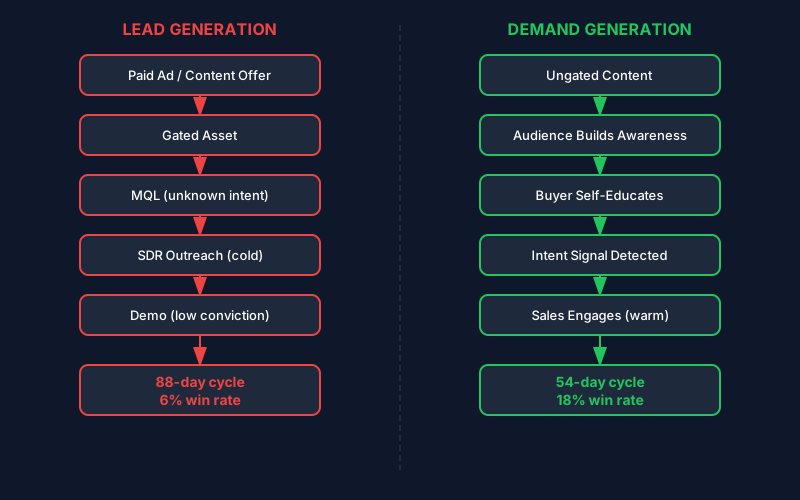
The structural difference shows up in every layer of the funnel. In lead gen, marketing's job is done when the form is submitted. In demand gen, marketing's job is done when the buyer is ready to have a real conversation about purchasing, and that's a completely different bar.
Why Lead Gen Feels Like It's Working (Until You Look at Pipeline)
Lead generation is seductive because it gives you numbers. Lots of them. Fast.
Run a LinkedIn campaign with a gated ebook on "10 Ways to Improve Your Data Strategy." You'll get downloads. Those downloads become MQLs. Your MQL number goes up. The dashboard looks great. Marketing gets to report that they generated 400 leads this month.
But then follow those 400 leads through the funnel. How many of them respond to the SDR's first outreach? Maybe 15%. How many book a demo? Maybe 5%. How many of those demos convert to an opportunity? Maybe half. How many of those opportunities close? A fraction.
I ran this exact analysis on three months of our MQL data, and the efficiency was brutal. For every 100 MQLs generated through gated content campaigns, fewer than 2 became closed-won revenue. The cost per closed deal, when you factored in ad spend, content production, SDR time, and the opportunity cost of sales reps working bad leads instead of good ones, was nearly 3x what it should have been.
The ICP I talk to constantly tells me the same thing in their own words: "We generate leads but pipeline doesn't close." That's not a sales problem. It's a lead quality problem, and the root cause is almost always a lead-gen motion that optimizes for volume at the top instead of readiness at the bottom.
The Operational Shift: What We Actually Changed
Switching from lead gen to demand gen isn't a campaign change. It's an operating model change. Here's what shifted, concretely, in how we ran marketing.
1. We Ungated Almost Everything
This was the hardest cultural shift. Marketing teams are emotionally attached to gated content because it's how they prove their value, in MQL numbers. Telling a marketing team to ungate their best content feels like asking them to work for free.
We kept gates on exactly two things: product-specific ROI calculators (where the user needed to input their own data, so the gate was justified by personalization) and late-stage comparison guides (where someone requesting the guide was a genuine buying signal). Everything else, blog posts, framework guides, industry reports, webinar recordings, went ungated.
What happened to our MQL number? It dropped by about 60%. What happened to pipeline? It went up. The people who did fill out a form were the ones who had already consumed three or four pieces of ungated content, understood what we did, and were ready for a real conversation. The forms weren't capturing random contacts anymore. They were capturing buying intent.
2. We Rebuilt the Content Strategy Around the Buyer's Timeline
Lead-gen content is designed to be attractive enough to justify a form fill. That incentivizes breadth and clickbait: "The Ultimate Guide to Everything." The content doesn't need to be good enough to build trust, because trust isn't the goal. Contact capture is.
Demand-gen content is designed to move a buyer through their own evaluation process, whether or not they ever give you their email. That incentivizes depth and specificity: real frameworks, specific numbers, named tools, honest failures.
We restructured our content calendar around the stages of our buyer's decision process:
Problem-aware content: Help the buyer understand and articulate their problem. Blog posts, LinkedIn content, short videos. All ungated. The goal is reach and resonance, not conversion. This is where my CRO content fits, helping growth operators see their funnel problems clearly.
Solution-aware content: Help the buyer evaluate solution categories and approaches. Comparison guides, methodology breakdowns, case studies. Mostly ungated, with a few gated pieces that serve as genuine intent signals.
Decision-stage content: Help the buyer choose you specifically. Product demos, ROI calculators, implementation guides. This is where forms live, because filling one out at this stage is a genuine buying signal, not a whitepaper download.
3. We Changed What We Measured
This was the metric shift that made everything else possible.
Old model: MQLs generated (monthly), cost per MQL, MQL-to-SQL conversion rate. Marketing was optimized around generating volume at the top of the funnel.
New model: Qualified pipeline generated (monthly), pipeline velocity (days from first touch to closed-won), win rate by source, revenue influenced by marketing content. Marketing was optimized around revenue contribution, not contact capture.
The moment you stop measuring MQLs as your primary marketing metric, you stop building campaigns designed to maximize MQLs. Obvious in retrospect. Nearly impossible to implement when your entire reporting infrastructure, your team's bonuses, and your board deck are built around MQL counts.
We didn't eliminate MQL tracking entirely. We still track it as a secondary metric. But the primary dashboard shows pipeline and velocity, and that's what we optimize for.
4. We Redesigned the Marketing-Sales Handoff
In the lead-gen model, the handoff was brutal for sales. Marketing threw contacts over the wall. Sales called them. Most didn't pick up. The ones who did said things like "I just downloaded the ebook, I'm not interested in a demo." SDR morale cratered. Marketing and sales blamed each other. The classic B2B dysfunction.
In the demand-gen model, we built a scoring system based on behavioral signals instead of demographic data. We stopped scoring leads based on job title and company size and started scoring them based on what they actually did.
A director-level contact at a 100-person SaaS company who downloaded an ebook? Low score. A mid-level product manager at the same company who visited our pricing page three times, read four blog posts, and watched the product demo video? High score. The second person is in a buying process. The first person was bored on a Tuesday.
I built an n8n workflow that monitored these intent signals across our web analytics and CRM, automatically adjusting lead scores based on behavioral patterns. When a contact hit the threshold, the workflow notified the sales team with a summary of exactly what the prospect had engaged with: which pages they visited, which content they read, how many times they came back. The SDR's first conversation stopped being "Hi, I see you downloaded our ebook" and started being "I noticed you've been evaluating our data collection capabilities. What problem are you trying to solve?"
That change alone compressed the average time from first sales touch to demo booked by almost 40%.
Pipeline Velocity: The Metric Nobody Talks About
Most B2B SaaS marketing teams obsess over pipeline volume. How many opportunities did we create? That matters, but it's only half the equation.
Pipeline velocity tells you how fast deals move through your funnel, and it's where demand gen fundamentally outperforms lead gen.
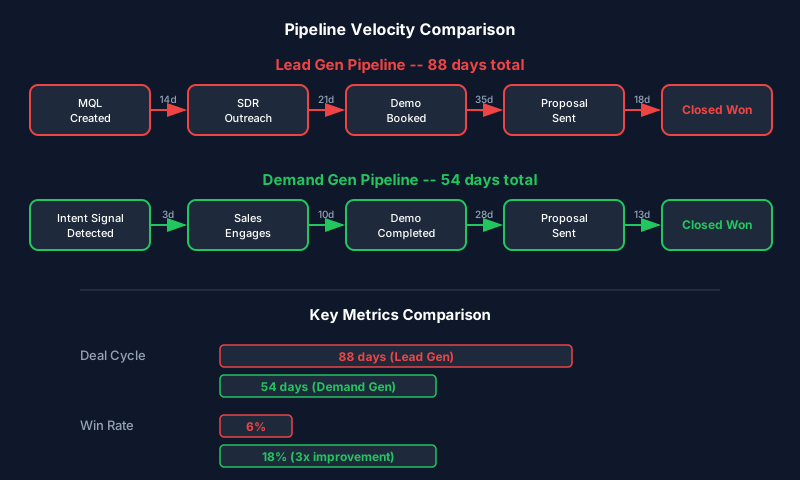
The velocity difference comes from one thing: where the buyer is in their decision process when sales first engages. In lead gen, the buyer is at the beginning. They just became aware of you because they downloaded something. In demand gen, the buyer has already been through their own research phase. They've read your content, compared you to alternatives, and decided they want to talk. The first conversation starts at a completely different point.
This is why our deal cycles compressed from 88 days to 54. Not because sales got better at closing. Because marketing got better at making sure buyers were actually ready before sales engaged.
The formula is simple: Pipeline velocity = (Number of opportunities x Average deal value x Win rate) / Average sales cycle length. Improving any of those four variables improves velocity, but shortening the sales cycle is the highest-impact move because it also frees up sales capacity. A rep who closes deals in 54 days instead of 88 can work more deals simultaneously. Demand gen doesn't just improve your pipeline. It multiplies your sales team's effective capacity.
The Content Engine That Feeds Demand Gen
Demand generation runs on content. Not gated lead magnets, but genuinely useful, specific, practitioner-level content that your buyer reads because it helps them do their job better.
Here's what our content engine looks like today.
Blog posts (like this one): Long-form, SEO-optimized pieces targeting specific problems our ICP faces. Each one is built around a real scenario, not generic advice. The goal is to be the best resource on the internet for that specific topic, so that when our buyer Googles the problem, they find us. The GTM strategy piece I wrote about regional expansion brought in more qualified inbound than three months of gated ebooks combined.
LinkedIn content: Short, opinionated posts that share real wins, real failures, and real frameworks. No motivational fluff. No "5 tips for success." Concrete situations with concrete outcomes. These create awareness and trust at the top of the funnel.
Ungated tools and frameworks: Templates, calculators, and checklists that the buyer can use immediately without giving up their email. The value is in the utility, and the brand impression that comes from being genuinely helpful without asking for anything in return.
AI-assisted distribution: I use n8n workflows to repurpose and distribute content across channels automatically. A blog post gets summarized into a LinkedIn post, key stats get pulled into email snippets, and the whole process runs without manual work. The AI doesn't write the original content, but it handles the distribution mechanics that would otherwise take hours every week.
The key insight is that demand gen content has to be good enough that people would pay for it. If your content reads like every other blog post in your category, it doesn't build trust or differentiation. It just adds noise.
Building Intent Signal Infrastructure
Demand gen without intent signal monitoring is just brand awareness with no measurement. You need infrastructure to detect when someone moves from "casually aware" to "actively evaluating."
Here's the signal stack I built.
Website behavior tracking: GA4 events on high-intent pages: pricing page visits, demo page visits, case study views, comparison page views. A visitor who hits your pricing page three times in two weeks is in a buying process. A visitor who read one blog post and bounced is not.
Content engagement scoring: An n8n workflow that tracks cumulative content engagement per contact. Reading one blog post: low signal. Reading four blog posts, watching a product video, and visiting the pricing page: high signal. The workflow aggregates these touchpoints and updates the CRM score automatically.
Third-party intent data: Tools that monitor when companies in your target account list are researching topics related to your product on third-party sites. When a target account starts Googling your product category, that's a signal that sales should be warming up the relationship, not waiting for a form fill.
Direct engagement signals: Newsletter opens (patterns, not individual opens), webinar attendance, social media engagement, event participation. None of these alone means much. In combination, they paint a picture of buying intent.
The whole system feeds into one dashboard that sales checks daily: a ranked list of accounts showing the highest buying intent based on aggregated behavioral signals. No more cold calling lists. No more "I downloaded an ebook six months ago" leads. Just accounts that the data says are actively evaluating solutions.
Common Mistakes When Switching to Demand Gen
I've watched several teams try to make this transition and stumble on the same problems. Here's what to watch for.
Mistake 1: Ungating everything overnight. Don't do this. Your leadership team will panic when MQLs drop by 60% in the first month. Transition gradually. Start by ungating one category of content and measuring the impact on pipeline quality over 60-90 days. Build the case with data before ungating the rest.
Mistake 2: Not changing how you measure marketing. If you switch tactics but keep measuring MQLs as the primary metric, your team will unconsciously drift back toward lead-gen behavior. They'll find ways to add gates back. They'll run campaigns optimized for form fills. You have to change the metrics first, or at least simultaneously.
Mistake 3: Expecting immediate pipeline results. Demand gen is a compounding motion, not a campaign. The first 90 days might feel like nothing is happening, because you're building awareness and trust with a buyer pool that won't need to purchase for weeks or months. If your leadership team needs pipeline results in 30 days, demand gen isn't the answer for that specific problem. Run a targeted outbound campaign for the short-term win while building the demand gen engine for the medium and long term.
Mistake 4: Producing mediocre ungated content. The entire model breaks down if your content isn't genuinely good. Ungated mediocre content doesn't build trust. It just shows your audience that you don't have anything valuable to say. Every piece of content should pass the test: "Would someone share this with a colleague because it's actually useful?"
Mistake 5: Treating demand gen as a marketing-only initiative. The marketing-sales handoff redesign is half the work. If sales doesn't buy into the new scoring model, the new engagement approach, and the new metrics, you'll have a great marketing engine feeding into the same broken sales process.
The 90-Day Transition Plan
If you're sitting on a lead-gen machine that generates volume but not pipeline, here's how I'd sequence the transition.
Days 1-30: Foundation. Audit your current pipeline data. Calculate your real cost per closed deal, including SDR time and opportunity cost. Build the business case for change. Set up intent signal tracking (GA4 events, content engagement scoring). Identify your top 3 pieces of content that could be ungated without risk.
Days 31-60: Pilot. Ungate those 3 pieces. Start publishing one piece of genuinely excellent ungated content per week. Build the intent scoring workflow in n8n or whatever automation tool you use. Train two SDRs on the new engagement model: reach out based on behavioral signals, not form fills. Run both models in parallel and compare pipeline quality metrics.
Days 61-90: Scale. You should have enough data to show that demand-gen sourced pipeline has higher win rates and shorter cycles. Use that data to expand the approach. Shift the primary marketing metric from MQLs to qualified pipeline. Ungate additional content categories. Roll out the intent-based engagement model to the full sales team.
Beyond 90 days: The compounding starts. Your content library grows. Your brand awareness increases. More buyers enter their evaluation process already knowing who you are. Pipeline quality improves month over month. Deal cycles continue to compress. And the sales team stops complaining about lead quality, because the "leads" they're getting are actually buyers.
The demand-gen versus lead-gen debate sounds theoretical until you've lived through the transition. When you've watched pipeline velocity jump and win rates triple because you stopped optimizing for email captures and started optimizing for buyer readiness, the theory becomes obvious.
Most B2B SaaS teams are stuck in lead-gen mode because it's measurable, it's familiar, and it produces numbers that look good on slides. Switching requires courage, patience, and an organizational willingness to trade short-term MQL vanity metrics for long-term pipeline quality.
The math doesn't lie. Demand gen companies close deals in 54 days versus 88 for lead gen. Not because demand gen is magic. Because when buyers come to you educated and ready, the entire selling process gets shorter, smoother, and more efficient.
If your pipeline is full of leads that don't close and your sales team is spending more time chasing than closing, the problem probably isn't at the bottom of the funnel. It's at the top. You're generating contacts, not demand.
If you want help making this transition, whether it's building the intent signal infrastructure, redesigning the marketing-sales handoff, or setting up the content engine that fuels demand gen, that's what my growth advisory engagement covers.
More tactics like this, straight to your inbox.