B2B SaaS Funnel Audit: How to Find and Fix the Leaks Killing Your Pipeline
A practitioner's framework for auditing your B2B SaaS funnel. Where the leaks hide, how to diagnose them, and the fixes that actually move pipeline numbers.
B2B SaaS Funnel Audit: How to Find and Fix the Leaks Killing Your Pipeline
Last quarter I sat down with a Series B SaaS company that was spending $180K/month on paid acquisition. Pipeline was flat. The VP of Marketing opened our call with a sentence I hear constantly: "Our funnel is leaky and we can't figure out where."
I asked for their funnel data. They had it, sort of. Top-of-funnel traffic numbers from GA4. Lead counts from HubSpot. Revenue from Salesforce. But nobody had mapped the full journey from first touch to closed deal with drop-off rates at every stage. They were staring at the inputs and the outputs without seeing what happened in between.
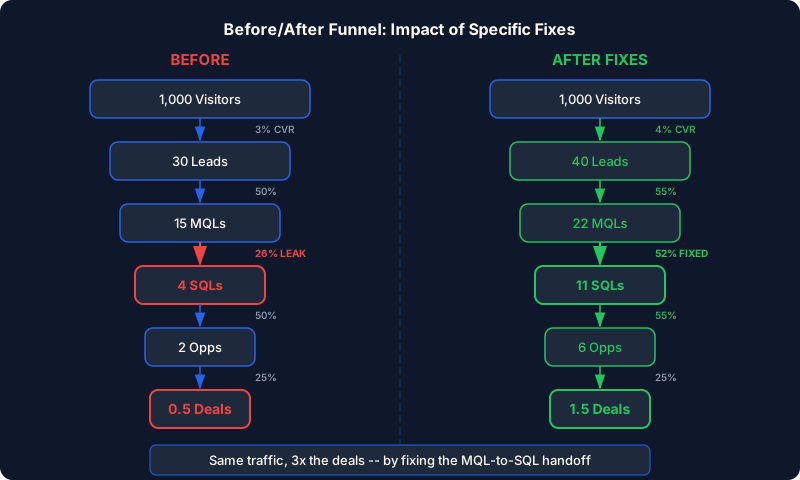
Two weeks later, after pulling their data, watching session recordings, and interviewing their sales team, we found the leak. It wasn't at the top. It wasn't at the bottom. It was the MQL-to-SQL handoff, where 74% of marketing-qualified leads were dying before sales ever touched them. Not because the leads were bad. Because the handoff took an average of 4.3 days, and by the time a rep reached out, half those prospects had already booked demos with competitors.
That's the thing about funnel leaks. They're rarely where you think they are, and they're almost never a marketing problem or a sales problem. They're a systems problem. This article is the framework I use to find them.
Why Most Funnel Audits Miss the Real Problem
Most teams approach funnel audits the way they approach a clogged drain: they start at the top and work down. Traffic looks fine? Move on. Landing page converting at 4%? That's "within benchmarks." Lead volume hitting targets? Must be a sales problem.
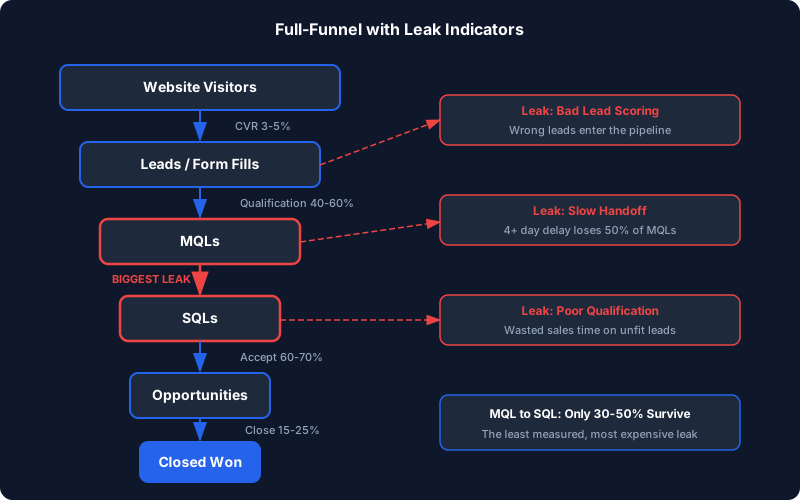
This top-down approach misses the most expensive leaks in B2B SaaS funnels, which almost always live in the middle stages. The space between "someone filled out a form" and "sales is working a real opportunity" is where pipeline goes to die, and it's the least measured part of most funnels.
I've audited dozens of B2B SaaS funnels over the past few years, and the pattern is remarkably consistent. Companies optimize what's visible (ad spend, landing pages, form submissions) and neglect what's invisible (lead routing speed, qualification accuracy, handoff processes). They're polishing the storefront while the warehouse is on fire.
The Five-Stage Audit Framework
Here's the exact process I run. It takes two to three weeks depending on data accessibility, and it produces a prioritized fix list ranked by revenue impact. Not "nice to haves." Fixes ordered by how much pipeline they'll recover.
Stage 1: Build the Full-Funnel Map
Before you can find leaks, you need to see the whole pipe. Pull 90 days of data and map every transition point.
The numbers you need:
- Website visitors to lead (form fill, demo request, signup)
- Lead to MQL (however your team defines "qualified")
- MQL to SQL (sales accepts the lead as worth pursuing)
- SQL to opportunity (a real deal in the pipeline)
- Opportunity to closed-won
Calculate the conversion rate at each stage. Then calculate the absolute number of leads lost at each stage. This is critical, because a 50% drop-off at a stage with 1,000 leads is a bigger problem than a 70% drop-off at a stage with 50 leads. Percentages lie. Absolute numbers tell the truth.
I use GA4 for top-of-funnel data, the CRM (usually HubSpot or Salesforce) for mid-funnel, and I cross-reference the two because they almost never agree perfectly. If your GA4 says you had 200 form submissions last month and HubSpot says 170, figure out why before you go further. That 15% discrepancy is either a tracking problem or a data hygiene problem, and both will poison your audit.
Stage 2: Find the Cliff
Once you have the map, look for the steepest drop-off. In my experience, there's usually one stage that's dramatically worse than the others. That's your cliff.
Common cliffs by stage:
Top-of-funnel (visitor to lead): If less than 2% of visitors convert, the problem is usually page-level. Your landing page isn't matching search intent, your CTA is buried, or your value proposition doesn't resonate. I covered this in detail in my CRO landing page framework, including the specific tests that moved our CVR by 18%.
Lead to MQL: If more than 60% of leads are disqualified, either your targeting is off (you're attracting the wrong people) or your lead scoring model is too aggressive. I've seen companies set MQL thresholds so high that perfectly good prospects get filtered out because they didn't download three whitepapers and attend a webinar first.
MQL to SQL (the usual suspect): This is where I find the worst leaks in most B2B SaaS funnels. Conversion rates here should be 40-60%. If you're below 30%, the problem is almost always operational: slow handoff, unclear routing, or sales reps cherry-picking leads and ignoring the rest.
SQL to opportunity: If sales accepts leads but doesn't convert them to opportunities, there's a disconnect between what marketing calls "qualified" and what sales considers worth pursuing. This is the marketing-sales alignment problem, and it kills more pipeline than any landing page issue ever could.
Opportunity to close: If your close rate is below 15%, the leak might actually be upstream. You might be creating opportunities from prospects who were never truly qualified, which inflates your pipeline numbers while keeping revenue flat.
Stage 3: Diagnose the Root Cause
Finding the cliff is step one. Understanding why it exists is where most audits fail. Teams see the data, jump to conclusions, and start implementing fixes without understanding the mechanism behind the problem.
For the Series B company I mentioned, the cliff was MQL-to-SQL. But "slow handoff" was a symptom, not a root cause. When I dug deeper, I found three contributing factors.
First, leads were routed by geography, but the EMEA rep was handling 3x the volume of the North America rep because the routing rules hadn't been updated after a territory change. Second, there was no SLA on response time. Nobody had defined "how fast is fast enough." Third, the notification system was an email that went to a shared inbox. Not a Slack ping. Not a CRM task with a deadline. An email that sat between newsletters and meeting invites.
The fix wasn't "respond faster." It was restructuring the routing rules, setting a 4-hour SLA, and moving lead notifications from email to Slack with an n8n automation that escalated untouched leads after 2 hours.
Diagnostic questions I ask at every stage:
- What's the average time between stages? (Speed kills, or its absence does.)
- Who owns the handoff? (If nobody owns it, nobody's accountable.)
- What information travels with the lead? (If sales gets a name and email but no context on what the lead did on the site, they're flying blind.)
- Is there a defined SLA? (If not, there's your problem.)
- What does the feedback loop look like? (Does sales tell marketing which leads were good? Does marketing adjust?)
Stage 4: Score Your Funnel Health
I use a simple scorecard to quantify funnel health across five dimensions. Each dimension gets a 1-5 score, and the total gives you a snapshot of where you stand.
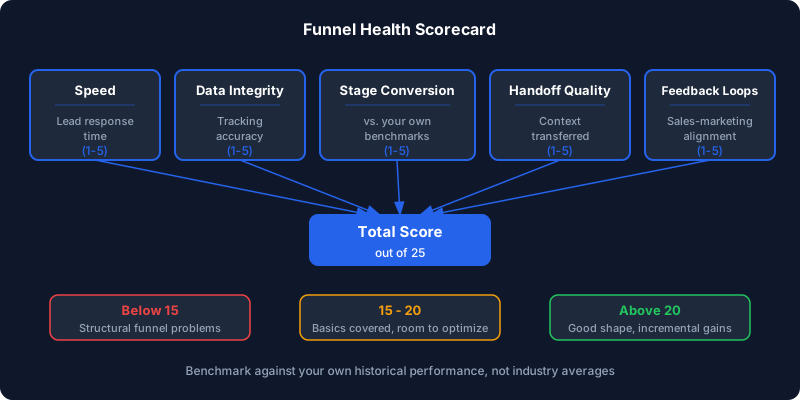
Speed (1-5): How fast do leads move between stages? A score of 5 means sub-1-hour MQL-to-SQL handoff. A 1 means days.
Data integrity (1-5): Do your tracking systems agree? Can you trust the numbers? A 5 means GA4, your CRM, and your revenue data tell a consistent story. A 1 means you're not even sure how many leads you got last month.
Stage conversion rates (1-5): How do your conversion rates at each stage compare to your own historical baseline? Not against industry benchmarks, which are misleading in B2B SaaS. Against your own best quarter.
Handoff quality (1-5): When a lead moves from one stage to the next, does the receiving team get enough context to act? A 5 means the sales rep sees what pages the lead visited, what content they downloaded, and what their company does. A 1 means they get a name and email.
Feedback loops (1-5): Does information flow back upstream? When sales rejects an MQL, does marketing know why? When a deal closes, does the team know which channel and content drove it? A 5 means tight bi-directional feedback. A 1 means marketing and sales blame each other in quarterly reviews.
A total score below 15 means you have structural funnel problems. Between 15 and 20, you've got the basics but significant optimization opportunities. Above 20, you're in good shape and looking for incremental gains.
Stage 5: Prioritize Fixes by Revenue Impact
Not all leaks are equal. A small improvement at a high-volume stage can be worth more than a big improvement at a low-volume stage. I rank every fix by estimated revenue impact, which forces hard decisions about where to focus.
The formula is simple: take the number of leads lost at the leaky stage, multiply by your historical conversion rate from that stage to close, multiply by your average deal size. That's the revenue at risk. Even if your fix only recovers 20% of that, you now have a dollar number attached to every initiative.
This is how I turned "we need to fix our MQL-to-SQL handoff" into "recovering even half of the leads we're losing at this stage would add $340K to quarterly pipeline." That second version gets budget approved. The first version gets added to a backlog that nobody reads.
The Four Most Common Leak Patterns
After auditing dozens of funnels, these patterns show up so frequently that I check for them first. They account for about 80% of the pipeline problems I find.
Pattern 1: The Slow Handoff
What it looks like: MQL-to-SQL conversion is below 30%. Lead response time averages more than 24 hours.
Root cause: No defined SLA, manual routing, leads buried in email or CRM queues.
The fix: Automate lead routing with assignment rules in your CRM. Set a clear SLA (I recommend 4 hours for inbound demo requests, same business day for content leads). Build an escalation workflow. I use n8n for this: if a lead isn't touched within the SLA window, it reassigns to a backup rep and pings the manager.
Expected impact: Companies that cut lead response time from 24+ hours to under 4 hours typically see MQL-to-SQL conversion improve by 30-50%.
Pattern 2: The Lead Scoring Black Box
What it looks like: Marketing says they're sending good leads. Sales says the leads are garbage. Both have data to support their position.
Root cause: The lead scoring model doesn't reflect what actually predicts a deal. It was set up two years ago based on assumptions, and nobody has validated it against closed-won data since.
The fix: Pull your last 50 closed-won deals and your last 50 disqualified leads. Look at what the closed-won leads actually did before converting. Which pages did they visit? How many sessions did they have? What content did they engage with? Rebuild your scoring model around those signals, not around theoretical assumptions about what "engaged" looks like.
I worked with one team that discovered their highest-converting leads never downloaded whitepapers (which gave the most points in their scoring model) but always visited the pricing page at least twice and the integrations page at least once. They rebuilt their scoring around actual buying signals, and SQL acceptance rate went from 35% to 58% in one quarter.
Pattern 3: The Content-to-Pipeline Disconnect
What it looks like: Top-of-funnel metrics look healthy. Blog traffic is growing. Content is ranking. But pipeline isn't growing proportionally.
Root cause: Content strategy is optimized for traffic, not for attracting buyers. The content brings in the wrong audience, or it doesn't connect to the next step in the funnel. Understanding the difference between demand generation and lead generation is essential here, because a funnel optimized for lead volume without demand creation will always underperform on pipeline quality.
The fix: Audit your top 20 content pages by traffic. For each one, check: does this page attract your ICP? Is there a clear path from this content to a conversion action? Is the conversion action appropriate for the reader's intent? A blog post about industry trends shouldn't push a "book a demo" CTA. It should offer something that matches the reader's stage: a framework, a tool recommendation, a related piece of content that takes them one step closer to a buying decision.
Pattern 4: The Vanity Pipeline
What it looks like: Pipeline numbers look strong. Close rates are terrible. Revenue targets keep getting missed despite "healthy" pipeline.
Root cause: Deals are being created from leads that were never properly qualified. The funnel moves bodies through stages without validating fit at each transition. Everyone looks busy. Nothing closes.
The fix: Tighten qualification criteria at the SQL stage. This will feel counterintuitive because pipeline volume will drop. That's the point. A smaller pipeline of real opportunities beats a bloated pipeline of wishful thinking. Define explicit criteria for what makes a lead an SQL: budget confirmation, decision-maker involvement, timeline, and genuine need. If a lead doesn't meet the bar, it stays an MQL and gets nurtured until it does.
Automating Funnel Monitoring (So You Catch Leaks Before They Drain Pipeline)
Running an audit every quarter is good. Knowing about leaks in real time is better. I set up automated monitoring using GA4 and n8n that flags conversion drops before they become quarterly problems.
The setup takes about half a day:
Build an n8n workflow that pulls your key stage conversion rates from GA4 and your CRM daily. Set threshold alerts: if any stage conversion drops more than 15% below its 30-day rolling average, the workflow fires a Slack notification with the specific stage, the current rate, the historical average, and a link to the relevant dashboard.
This catches problems like a broken form (landing page conversion suddenly drops to zero), a routing rule change that sends leads to an inactive rep (MQL-to-SQL conversion craters), or a seasonal traffic shift that changes lead quality (SQL-to-opportunity drops). Without automated monitoring, these problems can run for weeks before someone notices during a pipeline review.
I also set up a weekly digest that summarizes funnel health across all stages. It takes five minutes to read every Monday morning and surfaces trends that daily alerts might miss, like a gradual decline in lead quality that wouldn't trigger a single-day threshold but shows a clear pattern over two to three weeks.
If you're running A/B tests on your funnel simultaneously, statistical rigor matters even with low traffic. Automated monitoring helps you separate real conversion shifts from normal variance.
Running Your Own Audit: The Quick-Start Checklist
If you want to run this yourself, here's the condensed version. Block two weeks. Follow this sequence.
Week 1: Data collection and mapping.
- Pull 90 days of GA4 data for all funnel pages
- Export CRM data for leads, MQLs, SQLs, opportunities, and closed deals
- Map conversion rates at every stage
- Identify the cliff (biggest absolute drop-off)
- Watch 50+ session recordings on your highest-traffic funnel pages
- Interview 3-5 sales reps about lead quality and handoff experience
Week 2: Diagnosis and prioritization.
- Run root cause analysis on the cliff stage
- Score funnel health across the five dimensions
- Calculate revenue impact of each identified leak
- Build the prioritized fix list
- Design the first 2-3 fixes (start with the highest-impact, lowest-effort items)
- Set up automated monitoring so you'll know if things improve or get worse
What "good" looks like after the audit:
- You know exactly where your biggest leak is, with data to prove it
- You have a dollar figure attached to fixing it
- You have a prioritized list of 5-10 fixes ranked by revenue impact
- You have automated monitoring that will catch new leaks early
- You have a baseline to measure improvement against
Funnel audits aren't glamorous work. There's no single brilliant insight that fixes everything. It's methodical, data-heavy, sometimes tedious, and incredibly effective when done right. The companies that treat their funnel as a system to be monitored and optimized continuously, rather than a set-and-forget machine, are the ones that consistently grow pipeline quarter over quarter.
If your funnel is leaking and you can't figure out where, or you know where but don't have the bandwidth to fix it, that's exactly what my CRO audit covers. Two to three weeks, full diagnostic, prioritized roadmap with revenue projections attached to every fix.
More tactics like this, straight to your inbox.