How to Reduce B2B SaaS CAC Without Cutting Pipeline
Practical strategies to lower customer acquisition cost in B2B SaaS without sacrificing pipeline quality. Real benchmarks, real levers, real results.
How to Reduce B2B SaaS CAC Without Cutting Pipeline
I was looking at our Q3 acquisition numbers and something didn't add up. Pipeline was growing 15% quarter over quarter. Revenue was tracking. But CAC had quietly crept up 40% in six months, and nobody had flagged it because the top-line numbers looked healthy. We were acquiring customers faster, sure, but we were paying significantly more for each one. And most of that increase wasn't coming from where I expected.
I assumed paid spend was the culprit. It wasn't. When I broke the CAC waterfall down by component, the biggest growth was in manual labor costs: SDR time spent on unqualified leads, marketing ops hours wasted on campaign setup that could be automated, and sales cycles stretched by 20% because leads were entering the pipeline at the wrong stage. The ad spend was actually performing fine on a per-click basis. The inefficiency was everywhere else.
That discovery set off a systematic effort to cut CAC without reducing pipeline volume. Over the next two quarters, we brought CAC down by roughly 35% while pipeline actually grew. This article is the full breakdown of how, with the specific levers I pulled and what happened when I pulled them.
Where CAC Actually Lives (It's Not Where You Think)
Most teams think about CAC as a marketing spend problem. "Our CAC is too high" usually translates to "let's cut ad budget." That's the wrong instinct. Ad budget is visible, so it gets scrutinized. But in most B2B SaaS companies I've worked with, ad spend represents maybe 30 to 40% of total acquisition cost. The rest is hidden in salaries, tools, manual processes, and wasted cycles.
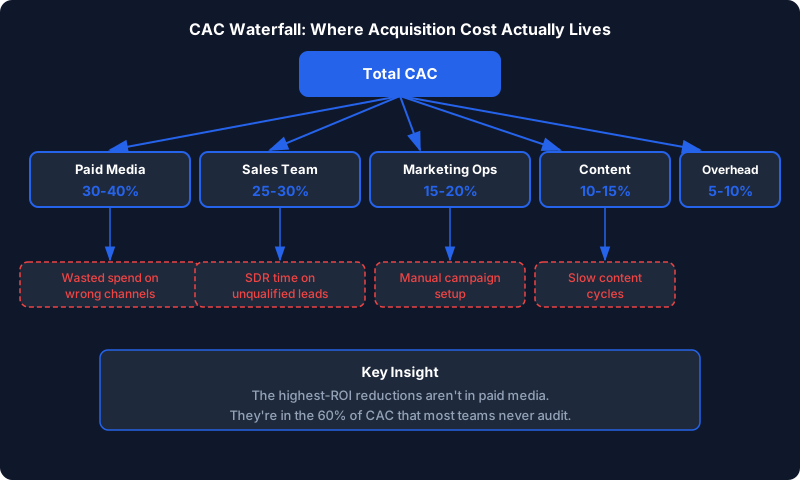
Here's a rough CAC waterfall for a typical Series A to B SaaS company running outbound and inbound motions:
- Paid media spend: 30-40% of total CAC. This is the number everyone stares at.
- Sales team allocation: 25-30%. SDR salaries, AE time on deals that shouldn't have entered the pipeline.
- Marketing ops and tooling: 15-20%. The CRM, the automation platform, the analytics stack, the people running all of it.
- Content production: 10-15%. Blog posts, landing pages, case studies, sales enablement material.
- Manual labor and overhead: 5-10%. The copy-pasting, the spreadsheet wrangling, the Slack threads asking "did anyone follow up on that lead?"
When I mapped our costs against this framework, the insight was immediate. The highest-ROI reductions weren't in paid media. They were in the 60% of CAC that most teams never audit.
Lever 1: Channel Mix Optimization
Not all channels produce pipeline at the same cost. That sounds obvious, but most B2B SaaS companies don't actually measure CAC by channel in a way that accounts for the full cost of working each channel.
We were running campaigns across LinkedIn Ads, Google Search, content syndication, and outbound email. Blended CAC looked acceptable. But when I broke it down by channel, the picture was ugly. Content syndication was producing leads at $35 per MQL, which looked efficient until we tracked those leads through to closed-won. The close rate on syndicated leads was under 2%, compared to 12% for Google Search leads and 8% for LinkedIn. The real CAC on content syndication, when measured against actual revenue, was 4x higher than Google Search.
We didn't cut content syndication entirely. We reduced spend by 60% and redirected that budget to Google Search campaigns targeting high-intent keywords. We also shifted some budget toward building organic content that targeted the same keywords. Within one quarter, blended CAC dropped 15% with no pipeline reduction. The pipeline mix actually improved because we were feeding sales higher-intent leads.
The takeaway: blended CAC hides channel-level inefficiency. Break it down by channel, but measure all the way to closed-won, not just to MQL. A cheap MQL that never closes is the most expensive lead in your pipeline.
Lever 2: CRO-Driven Efficiency (Fewer Wasted Clicks)
This is the lever most teams overlook when thinking about CAC. Every click you pay for that doesn't convert is wasted acquisition spend. If your landing page converts at 3% and you improve it to 4.5%, you just reduced the cost of every acquired customer from that channel by 33%, without spending a dollar less on ads.
I've written about this in detail in my CRO framework for B2B SaaS landing pages, but the CAC implication deserves its own discussion. The 18% CVR improvement I achieved through that sprint didn't just mean more leads. It meant each lead cost proportionally less to acquire. Same ad spend. Same traffic. More conversions. Lower CAC. The math is that simple.
The specific CRO changes that had the biggest CAC impact:
Landing page alignment with ad intent. We had a Google Ads campaign running on "B2B data enrichment tools" that pointed to our generic homepage. The homepage talked about our full platform, data collection, web scraping, proxies, everything. Someone searching for data enrichment tools had a specific need, and we were dropping them into a page that made them figure out which part of our product was relevant. We built dedicated landing pages for our top 5 ad campaigns, each matching the specific intent of the search query. Conversion rate on those campaigns improved by over 40%. Same spend, significantly more leads, lower per-lead cost.
Form qualification that reduces downstream waste. This connects to my earlier finding about form field optimization. We added a single qualifying question to our demo request form: company size range. It filtered out a chunk of leads that our sales team would have spent 30 minutes qualifying over a call before disqualifying. A small conversion rate dip on the form, but a meaningful reduction in sales team time wasted on leads that were never going to close. When you factor SDR time into CAC, that qualifying question saved us real money.
Lever 3: Automation That Cuts Labor Costs
The manual work hiding inside most B2B acquisition funnels is staggering. I've seen teams where SDRs spend 40% of their day on data entry, lead research, and CRM hygiene instead of actually talking to prospects. That labor cost shows up directly in CAC, and it scales linearly as you hire more reps.
Here's what we automated and the impact on CAC.
Lead enrichment and routing. We built an n8n workflow that takes every new inbound lead, enriches it with company data (size, industry, tech stack, funding stage), scores it against our ICP criteria, and routes it to the right SDR based on territory and segment. Before this workflow, an SDR would manually research each lead for 5 to 10 minutes before deciding whether to follow up. Multiply that by 50 leads a day across the team, and you're burning 4 to 8 SDR-hours daily on manual research. The workflow took two days to build. It handles the research and routing in under 30 seconds per lead. If you're interested in how these types of AI-powered workflows come together, I've written about the broader framework.
Campaign setup and reporting. Our marketing ops person was spending roughly 15 hours a week building campaign reports, updating UTM tracking spreadsheets, and setting up email sequences. We moved campaign reporting to automated dashboards and built templates for email sequences that pull dynamic content based on segment. That freed up 15 hours a week, which we redirected toward testing and optimization instead of maintenance.
Follow-up sequencing. We set up automated follow-up sequences in lemlist that trigger based on lead behavior, like visiting the pricing page or downloading a case study, rather than requiring an SDR to manually check and send. Response rates on automated behavioral triggers were actually 20% higher than manual SDR follow-ups, because the timing was better. The lead gets a relevant message within minutes of showing intent, not 24 hours later when the SDR gets around to checking the CRM.
Lever 4: Regional GTM Adaptation
This is the lever that's specific to companies expanding into new markets, and it's one where I've seen CAC blow up if you get it wrong. Running the same playbook across regions without adaptation is a reliable way to 3x your CAC in a new market.
When I led GTM expansion into APAC markets, the initial instinct was to translate our US campaigns and run them in new markets. The results were predictable. CAC in Japan was 3.5x our US baseline in the first month. The ads were technically in Japanese. The landing pages were translated. But the messaging, the social proof, the competitive positioning, none of it was adapted for how buyers in that market actually evaluate and purchase software.
We rebuilt the regional approach from the ground up. Local competitive comparisons (different competitors dominate in APAC than in the US). Region-specific case studies. Pricing presented in local currency with regionally appropriate anchoring. Messaging that reflected local buying committee dynamics, because in some APAC markets, the decision-making process involves more stakeholders and different approval hierarchies than what we were used to.
Within two quarters, Japan CAC dropped from 3.5x to 1.4x the US baseline. Still higher, which is expected for a newer market, but within a range that made the unit economics work. I've covered the broader regional GTM strategy in other writing, but the CAC angle is worth emphasizing: localization isn't a nice-to-have. It's a CAC multiplier.
Lever 5: Content as a CAC Reduction Engine
Paid acquisition has a linear cost curve. You spend more, you get more leads, CAC stays flat or increases as you exhaust high-intent audiences. Content has a compounding cost curve. The article you publish today continues generating organic traffic and leads for months or years, which means the effective CAC on content-sourced leads decreases over time.
But most B2B SaaS companies produce content that doesn't generate pipeline. They write generic thought leadership that ranks for nothing, attracts nobody who's actually buying, and exists primarily so someone can say "we have a blog" in a board meeting.
Content that reduces CAC is content built around commercial intent keywords that your buyers actually search when they're evaluating solutions. Not "what is CRO" explainer pieces, but "how to improve B2B SaaS conversion rates" guides that attract people who have the problem and are actively looking for a solution.
We mapped our content strategy to the buying journey. Top of funnel content that attracts organic traffic around problem-aware searches. Mid-funnel content that compares approaches and positions our methodology. Bottom-funnel content that addresses specific objections and provides proof points. Every piece was built with a target keyword, a clear internal linking strategy, and a conversion path.
After six months, organic content was generating 30% of total pipeline at roughly one-fifth the CAC of paid channels. That organic pipeline wasn't replacing paid. It was additive. But because it grew while its marginal cost approached zero, it dragged blended CAC down quarter after quarter.
The AI Angle: Where It Actually Helps (And Where It Doesn't)
AI has a real role in CAC reduction, but it's not the magic wand that most vendor pitches suggest. Here's where I've seen it genuinely move the needle.
Automated lead qualification. We use GPT-4 in our lead scoring workflow to analyze incoming lead data against our ICP profile. It reads the company description, website, recent news, and tech stack, then outputs a qualification score with reasoning. It's not perfect, maybe 80% accuracy compared to a human SDR. But it processes leads in seconds instead of minutes, which means our SDRs only spend time on leads that pass an initial AI screen. The 20% error rate is worth the time savings, especially since the SDRs catch obvious misscores quickly.
Content production efficiency. AI has cut our content production timeline from 3 weeks to about 5 days per article. Not by writing the content, it still needs a human perspective, real examples, and editorial judgment, but by handling research synthesis, first-draft structure, and SEO optimization. That means the same content team can produce 3x the volume, which directly accelerates the organic pipeline flywheel I described above.
Predictive channel allocation. This is still early for us, but we've started using historical channel performance data to build models that predict which channels will perform best for different segments and regions. Instead of allocating budget based on gut feel or last quarter's results, the model suggests allocation shifts based on trends in CAC, conversion rates, and lead quality by channel. The early results show about a 10% improvement in blended CAC from smarter allocation alone.
Where AI doesn't help (yet). It's not great at understanding regional nuances in messaging. It can translate and localize on the surface, but the cultural adaptation that actually moves CAC in new markets still requires human judgment and local market knowledge. It's also not a replacement for the strategic thinking behind channel mix decisions. The data processing is faster, but the "why" behind a channel shift still needs a human who understands the business context.
B2B SaaS CAC Benchmarks: What's Actually Normal
I'm cautious about benchmark data because it's easy to mislead yourself with averages. But directionally, here's what I've observed across the B2B SaaS companies I've worked with and benchmarks I find credible.
Typical B2B SaaS CAC ranges (mid-market, ACV $20K-$80K):
- Self-serve / product-led: $500-$2,000
- Sales-assisted with inbound: $3,000-$8,000
- Full enterprise sales cycle: $10,000-$30,000+
CAC payback period benchmarks:
- Strong: under 12 months
- Acceptable: 12-18 months
- Concerning: 18-24 months
- Red flag: over 24 months
CAC:LTV ratio targets:
- Healthy: 1:3 or better
- Acceptable: 1:2
- Needs attention: below 1:2
The most useful benchmark isn't an industry average. It's your own CAC trend line. Is it going up, down, or flat? If it's going up, do you know why? If it's flat, have you actually tried to reduce it, or are you just maintaining the status quo? If it's going down, is that because of genuine efficiency gains, or are you cutting spend and pipeline along with it?
The Compounding Effect: How These Levers Stack
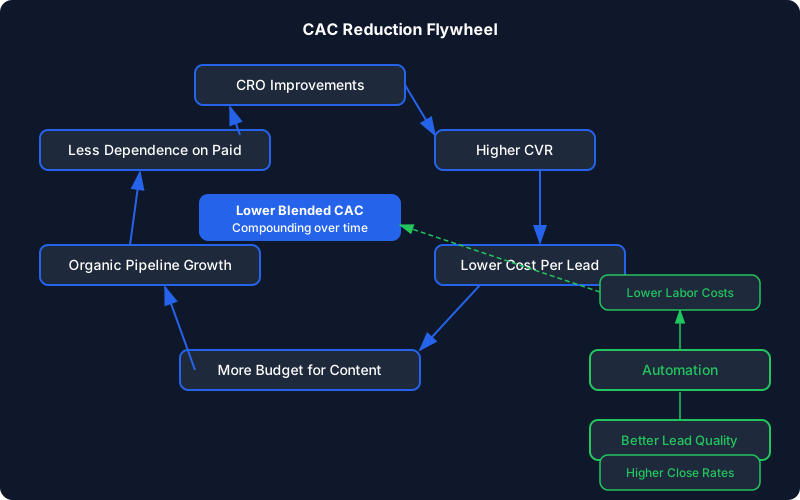
None of these levers work in isolation. The real CAC reduction comes from how they compound over time.
CRO improvements increase conversion rate, which means you get more leads from the same ad spend, which reduces cost per lead. Lower cost per lead frees up budget that you can redirect to content, which builds organic pipeline that has near-zero marginal cost. Automation reduces the labor cost per lead, which means your total CAC drops even as volume increases. Better lead qualification means sales spends less time on bad leads, which reduces the sales cost component of CAC. And all of this together means your CAC payback period shortens, which means you can reinvest in growth faster.
We saw this compounding effect clearly. In quarter one, we optimized channel mix. CAC dropped 15%. In quarter two, CRO improvements added another 10%. In quarter three, automation gains contributed another 10% reduction. And organic content was growing in the background the entire time, adding pipeline at lower and lower marginal cost.
By the end of two quarters, total CAC was down roughly 35% from where we started. Pipeline had actually grown 20% over the same period. The unit economics improved so meaningfully that we were able to increase investment in channels we'd previously considered too expensive, because the overall efficiency gains gave us room.
Where to Start
If your CAC is higher than you want it to be, here's the prioritized approach I'd recommend.
Week 1-2: Diagnose. Build your CAC waterfall. Break down total acquisition cost by component (paid, sales, ops, content, overhead) and by channel. Find where the biggest inefficiencies are hiding. You can't fix what you can't see.
Week 3-4: Quick wins. Fix the most obvious channel misallocations. If you have a channel with a 2% close rate eating 25% of your budget, redirect that budget now. Add qualifying questions to your forms. Set up basic lead scoring if you don't have it.
Month 2-3: Structural improvements. Build dedicated landing pages for your top campaigns. Implement automation for lead enrichment and routing. Start your content engine with commercially-intent keywords.
Month 4+: Compound. Run CRO tests continuously. Expand automation across more workflows. Measure and iterate on content performance. The gains compound, but only if you keep the machine running.
CAC optimization isn't a one-time project. It's an operating discipline. The companies that do it well don't just spend less. They spend smarter, and they build systems that get more efficient over time. That's the difference between cutting costs and building a growth engine that actually scales.
If your CAC has been creeping up and you can't figure out where the waste is, start with the waterfall. Map every dollar. The answer is almost always hiding in the 60% of costs that nobody's auditing. And if you want someone to run that diagnostic with you, that's part of what I do in a CRO audit or growth advisory engagement.
More tactics like this, straight to your inbox.